What is the difference between Invisalign clear aligners and traditional fixed braces?

What is the difference between Invisalign clear aligners and traditional fixed braces?

The most important differences

It is important to understand the fact that these two different orthodontic appliances move the teeth using fundamentally different techniques. Traditional fixed braces consist of brackets that are glued onto each individual tooth. The archwire (essentially a bent wire) is attached to these brackets, which pulls the teeth into their correct positions. The more modern invisible aligner is a plastic tray that, when placed over the dental arch, pushes the teeth into the proper position. You can find more detailed information about this procedure HERE.

Advantages and disadvantages

From the patients’ point of view, perhaps the biggest difference lies in aesthetics. Although aesthetic versions exist among traditional fixed braces as well, these cannot compete with aligners, since no metal parts are needed for these invisible trays to work. Another advantage, and this is mainly from the treating doctor’s perspective, is that the Invisalign appliance is custom-made specifically for your teeth. It is tailored precisely to your needs, your anatomical characteristics, and your dental irregularities, exactly reflecting the meticulously created digital treatment plan. As a disadvantage, I can only mention one thing, that these trays can be removed by the patient from the oral cavity. This may cause cooperation issues in people who are less cooperative (for example during childhood). The traditional fixed braces cannot be removed by the patient, so this problem cannot interfere with a successful treatment.

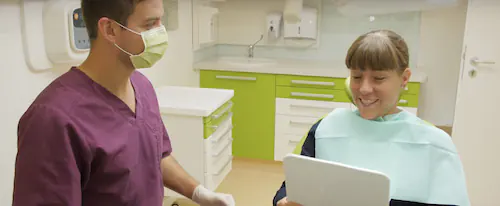
Fogorvosi konzultáción részt vevő páciens, aki a monitoron látható 3D-s fogsormodellre mutat, miközben a mellette ülő fogorvos figyelmesen hallgatja a kezelési terv megbeszélése közben.

Price differences

If I wanted to give a very short answer to this question, I would have to say that the invisible aligner treatment is a little bit more expensive than traditional treatment with fixed braces. Naturally, it is worth examining this question from several points of view. On the one hand, Invisalign is a modern, digital, and completely customized procedure, which in itself explains the higher price tag. Nevertheless, in simpler dental problems (those solvable with fewer trays), the price is similar to that of fixed-brace treatment. Moreover, there is no extra charge for each visit during the clear aligner treatment, but there is an activation price when we adjust the traditional orthodontic appliance. Another major advantage is that the whole price of the Invisalign treatment can be paid in three installments, whereas the full price of the fixed braces is due at the beginning of the treatment.

Fogorvosi konzultáción részt vevő páciens, aki a monitoron látható 3D-s fogsormodellre mutat, miközben a mellette ülő fogorvos figyelmesen hallgatja a kezelési terv megbeszélése közben.

Aesthetic considerations

As I already mentioned, the clear aligner is one of the most invisible types of orthodontic appliances. The lingual (inner) device may also compete for this title, but in that case, we must give up patient comfort in exchange. The brackets of the traditional fixed appliance are made from transparent sapphire crystal, making them invisible on their own, but the archwire tied into them is unfortunately always metallic in color, thus somewhat visible. Traditional metal fixed braces stand at the bottom of the aesthetic ranking, although this type of orthodontic appliance has the most favorable price.

Comfort considerations

Comfort is largely based on subjective perception. It is true, however, that most people tolerate the smooth surface of the invisible aligners better than the harder surfaces of braces. (Buccal fixed braces may irritate the lips, while internal lingual appliances may irritate the tongue.) Pain perception related to tooth movement is subjective. It is worth highlighting, though, that since each type of orthodontic appliance achieves results by moving the teeth, tooth sensitivity when biting down may occur during orthodontic treatment, regardless of appliance type. That being said, Invisalign uses an algorithm that applies minimal but continuous forces which are more tolerable by the patients.

Which appliance should I choose?

Based on the information described above, it is clear that deciding on this question is not an easy task. Ultimately, everyone must decide for themselves which type of orthodontic appliance best fits their needs, personality, and budget. In my opinion, the greatest thing is that modern orthodontics offers such a wide range of options for everyone. Of course, our doctors at Netfog Dental Clinic are happy to help you decide. You can ask as many questions as you like in order to be able to make the best possible choice. If you would like to visit our clinic, click HERE and book an appointment! The consultation fee will be credited toward the cost of the treatment, so it becomes free if you choose to undergo orthodontic treatment with us!

What is digital dentistry?

What is digital dentistry?

A few words about digital dentistry

Digital dentistry means that every step of a dental procedure is carried out with the help of computer technology, completely avoiding traditional, analog procedures (for example, impression taking). Needless to say, this method has revolutionized the dental workflow. Its spread is still somewhat limited due to the high cost of the necessary equipment. Moreover, the staff working with this technology also need further training to use it. But you don’t have to worry, because in our clinic all technological and professional backgrounds are provided for the smooth execution of digital dental procedures. If you would like to learn about the basis of digital dentistry, the intraoral scanner, and how it works, then click HERE!

What are the advantages of digital dentistry?

Digital procedures generally have many advantages over traditional ones. It is no different in dentistry. It allows for more precise, faster, and not least, more pleasant procedures for the patient. When I handed over to my patient the first crown I have ever made with digital technology, I was surprised at how precisely the edge of the dental restoration fitted the tooth. This precision is not achievable with traditional impression taking. Photographing the teeth with the intraoral scanner takes a quarter of the time required for taking impressions with impression material. Digital information also reaches the dental laboratory faster than an analog dental impression. Moreover, the dental technician does not have to spend time preparing the cast. However, from your point of view as a patient, the greatest advantage is that with the help of digital technology you can already see the expected final result of the treatment before the treatment even begins. Already at the first consultation you can see what your teeth will look like after the procedure! Personally, as a dentist, I also love this feature the most, since it greatly facilitates communication and helps a lot during consultations with my patients.

Does digital dentistry have any disadvantages?

As a disadvantage I can mention only one thing, that can also be a problem with any other digital procedure in today’s modern world. If the computer crashes, if the internet goes down, or if an error appears in the program for some reason, then indeed the scanning must be repeated, or the digital planning of the procedure must be restarted. A technical problem can cause delays as well. Fortunately, today there are so many safety protections built into the systems that this occurs very rarely. However, we must not forget that unexpected situations can occur in any area of life, which may sometimes require a solution.

What are the steps of a treatment using digital dental technology?

1. Preparation of the teeth

This step does not differ from the traditional procedure. It must be done with maximum precision and care in both cases. The teeth must be free from tartar and plaque. If tartar is present on the teeth, it must be removed. You can read more about tartar removal HERE.

2. Scanning of the teeth and oral structures

This phase replaces the traditional dental impression. With the intraoral scanner, we essentially take pictures of the teeth from every direction, and from this information the computer program creates a 3-dimensional image. Scanning is faster and gentler than traditional impression taking, since there is no impression material that can flow backwards toward the throat. You can learn about the scanning process by clicking HERE.

Fogorvosi rendelőben ülő páciens, akinek a fogorvos egy nagy monitoron digitális, 3D-s fogsor- és ínymodellt mutat be, gumikesztyűben a képernyőre mutatva.
Fogorvosi konzultáción részt vevő páciens, aki a monitoron látható 3D-s fogsormodellre mutat, miközben a mellette ülő fogorvos figyelmesen hallgatja a kezelési terv megbeszélése közben.

3. Digital planning

This is done in every case on a computer. This step is usually performed by the dentist in consultation with the dental technician. Of course, the artificial intelligence of the planning software also helps, but these suggestions can be modified by the professionals if necessary. Creating a good treatment plan is very important, as the dental restoration or the orthodontic clear aligner is manufactured based on this data. During the planning procedure, in our opinion, the most important thing is that the patient’s needs and requests are to be taken fully into account. If you would like to know how the digital treatment plan is created, then click HERE!

4. Manufacturing the dental restoration or invisible orthodontic aligner

Based on the plans, a CAD/CAM machine manufactures (by milling or 3D printing) the final product in the dental laboratory, which is then delivered to the dental office.

láthatatlan fogszabályozó tokban (invisalign)
Fogorvosi rendelőben ülő páciens, aki mosolyogva veszi át a fogorvostól az „Invisalign” feliratú kék ajándéktáskát a kezelőszék mellett.

5. Delivery of the dental restoration or clear aligner

In the clinic, the dentist checks the finished product, shows it to the patient, and performs small adjustments if necessary. If everything is in order and you, as a patient, are also satisfied with the final result, then the dentist hands over the invisible clear aligner or puts (cements) the dental restoration into its place. You can read more about the delivery of the completed dental work at the end of the digital workflow HERE.

Will digital dentistry completely replace traditional dental procedures at some point?

In the future, most certainly, but technology is not there just yet today. The completed dental restoration or orthodontic device is handed over to the patient by the dentist in the clinic. Strictly speaking, of course, this cannot be considered a digital step. At this appointment, the dentist can and sometimes have to make small adjustments to the finished product too, which is naturally an analog procedure. There is nothing wrong with this, since the tooth simulated in the computer program is not the patient’s real tooth, so the work is not completely finished when it arrives from the dental technician to the clinic. Furthermore, it must also be delivered to you or put into its place, which can only be done by a dental professional. Machines have not yet been developed for this step. Perhaps this is not a bad thing, since this way the human connection between the patient and the treating doctor is preserved. At Netfog Dental Clinic we truly believe that dentistry is not just a necessary bad thing, on the contrary, it can also be a pleasant experience spent in a good atmosphere.

Book an appointment in our clinic by clicking HERE and experience personally what a patient-centered dental procedure is like!

What types of orthodontic appliances exist?

What types of orthodontic appliances exist?

The classic categories: fixed or removable?

Traditionally, orthodontic appliances are classified into two major groups. Removable orthodontic devices, as their name suggests, can be taken out of the mouth and put back in by the patients. Fixed orthodontic appliances are bonded to the surfaces of the teeth by the dentist and can only be removed by the doctor. Generally, though not exclusively, removable appliances are the devices used mainly during childhood, while fixed orthodontic braces are used to treat adolescent and adult patients. Even in earlier times, there were cases that differed from this practice, but with the appearance of clear aligners (Invisalign), the previous trend was completely overturned. Since aligners can be used in the treatment of any age group starting from early childhood until adulthood. For more information about invisible clear aligners, you can click HERE!

What are traditional removable orthodontic appliances good for?

These orthodontic appliances are generally used for pre-treatment of patients. By pre-treatment, we mean the first step in solving some kind of complex dental problem. They are also useful for partial correction of large deviations. Removable orthodontic appliances are generally worn by patients during childhood, from the age of 8 to 12. Since they can only partially correct orthodontic problems most of the time, a second step with a fixed orthodontic appliance is always necessary, usually during adolescence. A major advantage of clear aligners like Invisalign is that with their help these two phases can often be solved in a single step. (Though not in all cases. For these instances there exists a special kind of aligner treatment option especially designed for patients with mixed dentition.) This can save a lot of time and money and, not least, spare our young patients from many inconveniences. Many types of removable orthodontic appliances exist; their indication is determined by the patient’s age, the specific dental problem, and the treating dentist’s preference. If you would like to learn more about treatment with removable orthodontic appliances, click HERE!

a girl holds an orthodontic appliance in her hand
invisible-braces-in-the-hand-of-a-doctor-in-gloves

What are invisible clear aligners?

Although patients can also remove this, we do not classify it among the traditional removable orthodontic appliances. Why not? Because in the tasks it performs, its role matches that of fixed braces. What is more, it often even surpasses them, as it is capable of combining the advantages of removable and fixed orthodontic appliances. With its help, individual teeth can be moved and set perfectly to their correct places. In addition, bite discrepancies can also be modified with it, such as the position of the jaw or the correction of deep bite.

And what about fixed orthodontic appliances?

Naturally, fixed orthodontic appliances were the tools of precision orthodontics for many decades. They still play an important role in treatments, as they are cheaper and more accessible than modern, invisible clear aligners, because the latter one requires serious technical and professional background. Another advantage is that we can even place colored elastics on the brackets, which can make wearing braces more attractive for children. There are many types of fixed orthodontic appliances. Some are aesthetic (invisible) and some are metallic. Some are bonded to the outer surfaces of the teeth, and some to the inner (lingual side) surfaces. There are also self-ligating orthodontic appliances, in which small latches hold the archwire (wire that moves the teeth) in place. In one respect, however, all fixed orthodontic appliances are the same, namely that they are made up of small units (brackets) that can be bonded to the teeth.

Are there any other types of removable orthodontic appliances?

On the borderline between the categories mentioned above, there exist certain types of orthodontic appliances that we have not yet mentioned. One such removable “orthodontic appliance,” which in fact does not straighten but merely holds the teeth in place, is the so-called retention plate, and this plays a very important role in ensuring that the teeth do not shift after orthodontic treatment. Thus, with the help of the retention appliance, we can avoid relapse after the treatment.

Are there any other types of fixed orthodontic appliances?

There exist fixed orthodontic appliances that can aid the main treatment in line with the braces or aligners. This procedure can be applied pre-treatment before starting the main intervention, for example, a palatal expansion with the hyrax appliance. Or in support of the main treatment process, for example, with anchorage-enhancing devices. External appliances outside the oral cavity also belong in this category, since they always have parts inside the oral cavity that are bonded in place. These appliances are used only in rare, more specialized cases, but in those cases they are indispensable.

Which orthodontic appliance is the most suitable for my teeth?

Answering this question can be an extremely complex task. Naturally, your individual preferences, as a patient, also play a role in the final decision. However, an orthodontic consultation cannot be complete without a thorough dental examination, intraoral scanning, and x-ray image analysis. Based on these, the orthodontic specialist can select the most suitable appliance and treatment plan for you.

Would you like to find out which orthodontic appliance would be the best for you? Then click HERE and book an appointment for an orthodontic consultation with our expert! In our clinic, the consultation is free if you undergo your orthodontic treatment with us.

The price of the consultation is credited toward the price of the orthodontic appliance.

What is the intraoral scanner and how do we use it during dental treatment?

What is the intraoral scanner and how do we use it during dental treatment?

What exactly is an intraoral scanner?

The task of scanners is to take a photograph of something, whether it is a document on a sheet of paper or a three-dimensional object. It’s no different about scanners used in dentistry. With their help, the teeth and the structures of the oral cavity can be photographed. Put very simply, one could say that they replace traditional dental impression taking. In reality, they can be used for far more, and they open new possibilities during dental treatment. Their use made the development of digital dentistry a reality, about which you can read more by clicking HERE.

Fogorvosi rendelőben konzultáló páciens és fogorvos: a kezelőszékben ülő nő a szakember felé fordul, aki bordó munkaruhában, gumikesztyűben egy mobil monitor mellett ülve ismerteti a kezelési lehetőségeket.

How does the intraoral scanner work?

The scanner is placed into the oral cavity, and the dentist scans over the teeth and the oral structures (for example, the palate). The scanner takes thousands of photos during the procedure and assembles them into a three-dimensional image, which is actually a large digital file. (Processing the data requires a high-performance computer.) The completed file contains a vast amount of information about every tiny detail of the scanned structures. The data can be easily shared with the dental technician via the internet, or it can also be stored in the cloud for any amount of time. You can read more about the specific steps of the dental treatment with the intraoral scanner in THIS article.

Is intraoral scanning painful for the patient?

No. Scanning inside the oral cavity is completely painless. Moreover, it takes much less time and is far less uncomfortable than traditional impression taking. Another advantage is that in case of an error, the entire process does not need to be repeated, because it is possible to re-scan only the problematic area (for example, a single tooth).

When is the intraoral scanner used during dental procedures?

1. Digital impression taking for fixed dental restorations

When preparing dental bridges and crowns, the prepared tooth stumps and the surrounding oral structures are digitized with the help of the intraoral scanner. You can read more about dental crowns and dental bridges by clicking HERE.

2. Digital impression taking for clear aligners (Invisalign) and lingual braces

The first step in the clear aligner or lingual orthodontic treatment is to digitize the patient’s teeth. The orthodontic appliance, the invisible aligners, or the lingual braces are then made with the help of this digital model and the digital treatment plan. You can read about Invisalign clear aligners HERE.

3. Digital impression taking for dental implants

The position of dental implants can also be recorded using special scan bodies intended for intraoral scanning. You can read more about dental implants HERE.

4. During the fabrication of inlay and onlay restorations

The places for these restorations must be properly prepared using cavities drilled into the teeth. Digital impressions of these cavities can also be taken with the intraoral scanner. You can read about inlays and onlays by clicking HERE.

5. Digital impressions needed for veneer restorations

Before making veneers, a small amount of the tooth structure must be removed. A digital impression can also be taken by intraoral scanning of the prepared surface and the surrounding teeth.

6. For documentation purposes

We can take a digital impression of your teeth at any time. This information can be stored for many years, and the data is retrieved when needed. In case of tooth damage or loss, your original smile can be restored based on the information in the digital impression.

7. To facilitate dental consultation

After photographing the teeth, they can be displayed on a computer monitor. This greatly facilitates dental consultation by showing patients any possible abnormalities. Be it a decay developing on a tooth or tartar accumulation on the inner surfaces of the teeth.

8. For detecting hidden tooth decay

The latest iTero Lumina scanner, using NIRI (near-infrared imaging) technology, can detect cavities forming between the teeth. This method is more accurate than searching for decay with X-rays, and moreover, it has no harmful health effects.

What are the advantages of digital impression taking compared to traditional methods?

1. Speed

Scanning the teeth is a much faster process than taking a traditional impression. There is no need to struggle with choosing the proper impression tray. There is no need to wait for the impression material to harden. And the entire process does not need to be repeated if the impression has a fault.

2. Accuracy

When I used an intraoral scanner for the first time in my life, I couldn’t believe my eyes at how detailed the image produced by it was. The next surprise came when the crown made, based on this digital information, fit the tooth so perfectly that I had never experienced with traditional impressions.

3. Comfort

Needless to say, from the patient’s perspective, “photographing” inside the mouth is much more pleasant than enduring runny impression materials and large impression trays.

4. Vast array of possibilities during treatment

With the introduction of digital dentistry, countless new and groundbreaking possibilities have become available. The flow of information between professionals has accelerated. The file created by intraoral scanning can be used for any purpose to ensure successful and efficient dental treatment. The data can be stored indefinitely, in a space-saving way and is easily accessible.

5. Incredibly impressive

When I show someone a 3-dimensional scan of their teeth for the first time in their life, it is usually met with great interest and excitement. On the digital image, we can literally show anything to the patient about his teeth. We can even draw on the picture or add notes. (These images can be downloaded to your phone or computer with the help of a personalized QR code.) All this greatly facilitates communication and consultation. Moreover, with the help of artificial intelligence, even during the very first consultation you can already see what your smile will look like after dental treatment!

Fogorvosi rendelőben ülő páciens, aki sárga védőkötényt viselve figyeli a fogorvost, miközben ő gumikesztyűben egy mobil monitoron látható színes 3D-s fogsormodellre mutat.

If you would like to take part in the digital revolution of dentistry, then visit our clinic for a consultation! You can book an appointment by clicking HERE.

What happens during an orthodontic consultation?

What happens during an orthodontic consultation?

Why is it important to have a consultation before orthodontic treatment?

Like every dental procedure and treatment, the process of orthodontics also begins with a long and thorough consultation that addresses every important question on the subject. This is the first and one of the most important steps of orthodontic treatment. In most cases, this is when the patient meets his or her future doctor. Naturally, this is also when the orthodontic specialist meets the patient, or in the case of a child, the child’s relatives, whom he will be continuously treating over a long period of time. Of course, it also sometimes happens that a client who has been a patient in general dentistry decides to start orthodontic treatment. However, even in this case, it is important that during a special appointment we deal exclusively and solely with the matter of aligning the teeth. (In such cases, we can usually waive the assessment of general diseases and the general condition of the dentition.) Whit this said, let’s look at what the most important steps of an orthodontic consultation are, in consecutive chronological order! (At the Netfog Dental Clinic, the orthodontic consultation fee for orthodontics is credited toward the price of the orthodontic treatment.)

Fogorvosi rendelőben ülő páciens és a vele szemben ülő fogorvos, aki gumikesztyűben, egy mobil monitor mellett ülve magyarázza a közelgő kezelést.

1. Discussing general diseases (anamnesis)

Before performing any medical procedure, it is extremely important for us doctors to be aware of the patient’s general state of health, to know about any possible allergies, and to learn what medications they take regularly. It is important to mention past surgeries, major medical interventions, and in the case of women, whether someone is expecting a baby.

2. Discussion with the patient about their expectations regarding orthodontics

If I had to highlight one thing from my many years of experience that is the most important for a successful orthodontic treatment, it would be exactly this topic. In my opinion, this thing is to precisely understand your expectations as a patient, your goals, and the underlying motivation that drives you to begin the treatment. Without understanding these, the dentist may not necessarily guide the treatment process in the right direction or with the proper methods.

3. Examination of the general condition of the teeth and the oral cavity

Although some people are interested only in the topic of getting their teeth straight, it is impossible to create an accurate and safe orthodontic treatment plan without examining the teeth and the periodontium. For example, orthodontic treatment cannot be started in the presence of decayed teeth or tartar. In the case of a weakened periodontium, we may need a colleague specialized in periodontal diseases (a periodontist), and the treatment plan must also be adjusted accordingly. Oral surgery may also be necessary if we find a tooth that needs to be surgically removed or extracted. In short, before starting orthodontics, we must address general dental problems. This is in the patient’s best interest, and for the dentist it is an obligation by profession.

4. Examination of the positioning of the teeth and the contact between the lower and upper dental arches (occlusion).

Since orthodontics involves aligning teeth and correcting bite irregularities, it is extremely important to form an accurate picture of the initial condition. Based on this, we visualize the goal of the treatment and decide how we can achieve this goal.

5. Taking and evaluating X-ray images


X-ray diagnostics are an essential component of the orthodontic consultation. Before starting any treatment, it is necessary to take at least a panoramic X-ray (Panorex). With its help, we can detect the presence of teeth stuck in the jaw or missing teeth (aplasia), and we can also notice general dental problems such as tooth decay or periodontal disease. As a supplement, we may take a cephalometric X-ray or even a 3-dimensional CT scan.

6. “Photographing” the teeth with an intraoral scanner


Before clear aligner (Invisalign) treatment, it is necessary to scan the teeth and oral structures, based on which we can prepare the digital treatment plan. If the patient decides on Invisalign treatment, then the aligners are also manufactured in the laboratory based on the information stored during the scanning (digital impression). You can get more information about the intraoral scanner by clicking HERE.

7. Explaining the treatment plan.

Based on all the information obtained during the previously mentioned examinations, the orthodontic specialist prepares the treatment plan. This plan is presented to you in a clear and understandable manner, and the doctor explains what problems the orthodontic procedure will aim to solve and what final result can be expected at the end of the treatment. Naturally, you can also ask your questions and make suggestions to modify the plan. If these changes are allowed by professional standards, then your dentist will modify the treatment plan accordingly. Since there is no such thing as a bad comment or too many questions, we encourage every patient to actively participate in the planning process. Over the years, I have received countless useful pieces of information from my patients, and their questions have often shed light on important matters that might otherwise have been overlooked.

What is the next step after the consultation?

The patient can choose between two options after receiving the price quote and all the information regarding their teeth and the orthodontic treatment plan. If he or she decides to start the treatment, then we schedule the appointment to begin with the orthodontic procedure. He or she may also choose to think over what they heard and request an appointment for a follow-up consultation. At our Netfog Dental Clinic, the follow-up consultation is free of charge (and the price of the first consultation is deducted from the cost of the orthodontic appliance), so it is worth taking advantage of this option if you need time to think before starting orthodontics. If we have piqued your interest and you would like to visit our clinic for a consultation, then you can request an appointment by clicking HERE.

How is the digital treatment plan created for the invisible aligners (Invisalign)?

How is the digital treatment plan created for the invisible aligners (Invisalign)?

A few sentences about the digital treatment plan

Based on the intraoral scan, we digitalize the initial positions of the teeth. In the computer-based planning program, the orthodontic specialist can set what the final positions of the teeth should look like. The dentist can also precisely plan the steps through which we will reach our goal. The most wonderful thing is that at the end of the planning process we can show the final result, what you can expect by the end of the orthodontic treatment. And if you happen not to agree with something we have planned, then the treating doctor can easily modify the plan with just a few clicks. You can find more information on the topic of digital dentistry by clicking HERE.

The steps of the digital treatment plan process are as follows

1. Orthodontic consultation

After examining the teeth, and x-rays and talking with the patient, we decide together which orthodontic appliance will be the most suitable for carrying out our treatment goal. If you choose the invisible aligner (Invisalign), then the next step will be digitalizing the teeth and intraoral structures. You can read more about the orthodontic consultation HERE.

2. Photographing the teeth with an intraoral scanner

The good news is that the whole process only takes a few minutes. It is completely painless, and you do not need to fear the kind of discomfort you would experience during a traditional impression. You can immediately view the result of the procedure after the scan, and in fact, you can already see a preview image during the process. In my experience, the most difficult part of the scanning process is that patients always want to turn towards the monitor because they are so curious about the 3D image of their teeth. However, they do not need to wait long, because in the next step we will thoroughly evaluate the situation in their mouth and they can also take a look of the created image. If you are interested in what device we use in our clinic for digital scanning of the teeth, then click HERE!

Fogorvosi rendelőben ülő páciens, aki előrehajolva figyeli a nagy monitoron látható 3D-s fogsormodellt, miközben a fogorvos gumikesztyűben a képernyőn az eredményt magyarázza.

3. Viewing the scanned image and the preliminary smile design

After digitalizing the teeth, you can immediately look at the image on the large screen of our modern iTero intraoral scanner. With the help of modern technology, your orthodontist will demonstrate on your teeth what dental problems need to be solved and in what way can we achieve this goal. Furthermore, you can see, on the photo taken of your face or even on a video made of you, what your smile will look like at the end of the treatment. (The expected final result of the orthodontic treatment is fitted into the place of your original teeth by a program using artificial intelligence.)

4. Digital planning using the Invisalign computer program

If you decide on going with the clear aligner treatment, then your dentist will prepare the digital treatment plan for you. The planning process takes approximately 1 week, and once it is completed, we can tell you exactly how many aligners you will need during the treatment and which treatment package is most suitable for your teeth. At this time, we will also be able to provide you with precise information about the cost of the treatment. Naturally, our experienced orthodontists can already predict, with great certainty, during the first consultation into which package the treatment will likely fit. It is important to note, however, that this is only an informative estimate, because preparing the precise treatment plan requires a longer and more detailed evaluation. I would also like to draw the attention of our future patients to the fact that the digital planning has a separate fee. This does not mean that you must request the invisible aligner treatment after the planning, but we won’t be able to refund the planning fee once the digital treatment plan has been completed. (The planning process requires a lot of time and energy investment from the doctor.) Therefore, it is worth carefully considering which orthodontic appliance the patient choses for the treatment, because traditional fixed braces do not require digital planning, so that cost can be saved.

Fogorvosi konzultáción részt vevő páciens, aki a monitoron látható 3D-s fogsormodellre mutat, miközben a mellette ülő fogorvos figyelmesen hallgatja a kezelési terv megbeszélése közben.

5. Presenting the digital plan and the final treatment results to the patient

During a second consultation, the orthodontist explains the steps and shows the expected final result of the treatment. The doctor also informs the patient which treatment package is most suitable for him or her, and how much this will cost. We provide the price of the treatment precisely, without hidden costs, for the entire duration of the orthodontic process. We also provide a written price quote. (Even a future increase in the clinic’s prices cannot change this afterwards.) Naturally, you may ask questions and suggest modifications to the treatment plan as well. If the requested change does not conflict with professional standards, your treating doctor will carry out the modifications immediately. If you would like to learn about the different treatment packages used in relation to the clear aligner (Invisalign) orthodontics, and how many aligners they include, then click HERE!

Digital treatment planning, the future of dentistry

After reading the above, it must be clear what great advantages digital planning provides during dental procedures. At the moment, only certain fields of dentistry (for example orthodontics) enjoy the benefits of this technology. However, we can expect that slowly, but possibly even faster than anticipated, digital dentistry will spread everywhere. If you would like to be among the first to try out this cutting-edge technology, currently considered the most modern, then by clicking HERE you can book an appointment for a digital orthodontic consultation.

In our clinic, the consultation is free of charge if you choose to undergo orthodontic treatment with us. (The consultation fee is credited toward the price of the orthodontic appliance.)